
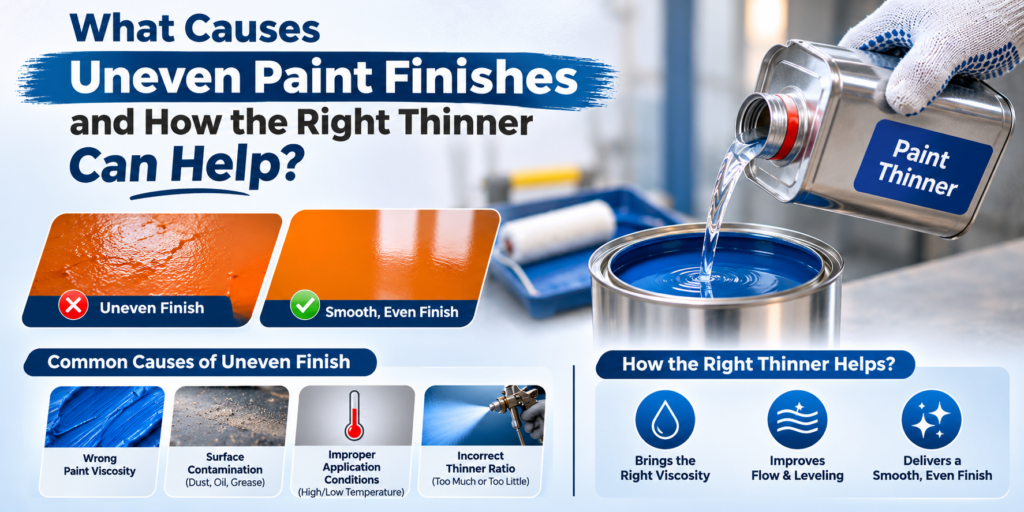
You have chosen a good quality paint and have prepped your surfaces ready to apply your final coat. However, when you switch the lights on, you start to notice an uneven finish.
There are many reasons you could be getting an uneven finish. But paint is a full system. Using the correct combination of paint, solvent, substrate, tool and environmental conditions will help you achieve the perfect finish. A commonly missed item in the system is using the correct paint thinner. Using the correct paint thinner will help but not completely fix your issue. Using the correct thinner will eliminate a key reason for your issues.
Why You’re Getting An Uneven Finish
There are typically 6 reasons why you’re getting an uneven finish.
Incorrect Thinner Ratio
If you add too much thinner to your paint it will make it extremely thin. This will cause poor coverage and runs. If you add too little, it will make your paint extremely thick. This will cause poor flow, ridges and poor spray. Start by using the recommend ratio.
Incorrect/Poor Quality Thinner
Thinners contain different solvents. These must be compatible with the paint and resin chemistry. If they are not, you will notice cloudy paint, poor mixing and issues with the finish. Using a poor quality thinner with inconsistent properties will cause an uneven flash off.
Poor Surface Preparation
Issues with dust, oils, old flaking paint, trapped moisture and inconsistent sanding will affect your paint performance. Porous areas will absorb more paint than sealed areas causing an uneven sheen. No amount of thinner will help if the surface wasn’t prepared correctly.
Poor Application
Brushing too much, inconsistent pressure with a roller, inconsistent distance with a spray gun, inconsistent speed with a spray gun and painting into semi dry areas will cause visible issues. This is a common issue with paint. Even with the perfect mix, you will still see issues.
Incorrect Drying Conditions
If it is hot and windy, the surface will dry too quickly. This will cause issues with the paint not levelling. If it is cold or humid the paint will dry slowly causing issues with dust pickup, runs and cloudy finish. A common issue is painting in direct sunlight.
Poor Mixing
Pigments and flattening agents will settle. If you don’t mix properly you will notice issues with colour and gloss.
Benefits Of Using The Correct Thinner
Thinners are not simply used to thin the paint. Using the correct thinner will help with:
Correct Viscosity
Viscosity refers to how thick your paint is. Depending on your application method, you need a specific viscosity. Using the correct thinner will give you the correct viscosity.
Improved Flow & Levelling
Levelling refers to your paint evening out any brush/roller marks. Using a compatible thinner will ensure your paint has enough time to remain in a wet state.
Improved Spray Performance
Thick paints will cause splatter and an orange peel effect. Using the correct viscosity will help the paint to break into fine even droplets.
Improved Drying
Different thinners have different flash off times. If it dries too quickly you may get a skin forming. This will cause issues with solvent lock and pinholes/blushing. If it dries too slowly you may get runs and dust. Some systems will use a retarder in hot/dry conditions.
A good point to note is that thinners are tools. If the surface isn’t clean, application is poor or the weather is bad, the thinner will not help.
Signs You’re Using The Wrong Thinner
Orange Peel
This is caused by a bumpy surface like the skin of citrus fruit. This is typically caused by the paint being too thick or the solvent flashing off too quickly.
Uneven Finish
If the thinner isn’t compatible with the paint you may get an uneven finish.
Brush/Spray Marks
If the paint isn’t levelling you will get brush/spray marks.
Dull Finish
If the solvent balance is incorrect you may get issues with the finish.
Drying Too Slowly/Fast
This can be a sign that the thinner isn’t the correct flash off.
Poor Flow & Levelling
The paint will feel sticky and streaky.
These can be caused by a few things. Ensure you’re using the correct ratio, surface preparation and conditions.
Choosing The Correct Thinner For Your Paint
There is no ‘one size fits all’ answer. It depends on what type of paint you are using.
Type Of Paint
Depending on whether you are using nitrocellulose lacquer, PU, epoxy, enamel, melamine or stoving, the resin chemistry will be different. Ensure you are using a compatible thinner.
Application
Depending on whether you are brushing, rolling or spraying, you will need a different viscosity. Spraying requires the thinnest paint whereas brushing will require more body.
Viscosity
Try to use the recommended viscosity from the paint manufacturers. Add the thinner slowly.
Conditions
If you are painting in hot, dry or windy conditions you may want to use a slower solvent or add a retarder. If it is cool and humid you need to be cautious about drying times.
Recommended Ratio
The most reliable source is the product label and TDS. Check what type of thinner, ratio and application notes are required. If unsure, try a small panel.
Why Using A Quality Thinner Will Help
Using a compatible and consistent thinner will help you get a more predictable outcome. This will give you a smooth application, less issues with your spray and less redo’s. Using an inconsistent quality of solvent will cause issues with your finish. This can be difficult to trace.
Bluedip Paints & Chemicals are a manufacturer of alcoholic and non-alcoholic thinners and industrial solvents based in Ghaziabad. They were founded in 1969 and hold ISO 9001:2015 certification. They offer a wide range of thinners including N.C. thinner, epoxy thinner, enamel thinner, P.U. thinner, melamine thinner, stoving thinner, wood polish thinner, universal thinner, retarders and turpentine oil. As they offer a range depending on the paint type, it will be easier to find the correct one for your coating system. As always, check the TDS for your paint to ensure compatibility.
FAQs
Can using the wrong paint thinner cause an uneven finish?
Yes. Using an incompatible or incorrect flash off thinner can cause issues with an uneven, orange peel, poor levelling and dull spots. Surface preparation and application will also play a role.
How Much Should I Add?
It depends on what type of paint and application you are using. Check the product label or TDS for the correct ratio. Add the thinner slowly.
What Is Viscosity?
Viscosity refers to how thick your paint is. If it is too thick/thin for your application, you will get brush marks, splatter, runs and poor coverage.
Is There A Universal Thinner?
No. It depends on the chemistry of your paint. There are universal thinners but always ensure they are compatible with your paint system.
Can I Just Change My Thinner To Get An Even Finish?
Rarely. Using a better thinner will help with flow and drying but ensure your surface was prepared, application, mixing and conditions were correct.